The Decision-Ready Evidence Standard: How Operators Validate Market Demand Without the...
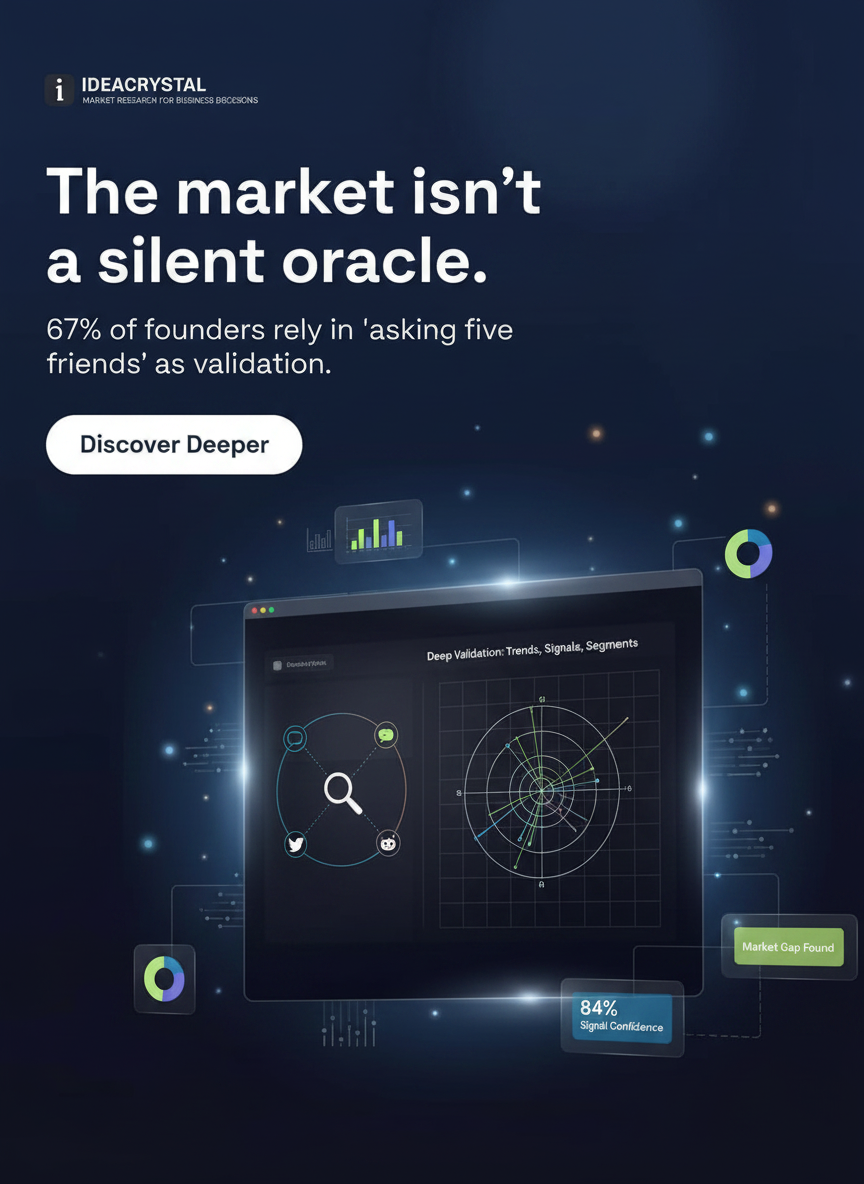
The most repeated advice in startup circles is to "listen to the market." But the market is not a silent oracle you interrogate with a single interview or a Twitter poll. Most operators, consultants, and product strategists conflate validation with asking five friends, running a quick ad test, or scrolling through Reddit for an afternoon. That is not listening. That is noise-sampling with confirmation bias baked in.
When you are about to spend time, money, code, content, team focus, or client trust on a new direction, you cannot afford to rely on vibrations. You need a verdict with receipts. This article outlines the Decision-Ready Evidence Standard—a structured framework designed for technical founders, SaaS builders, and product strategists who need to validate what to build, launch, pitch, reposition, or expand next using real market signals instead of guesses or generic AI advice.
The Illusion of Validation: Why Most Market Research Fails
Traditional market research often falls into two extremes: academic over-analysis or superficial gut checks. Academic research takes months, resulting in dense reports that are outdated by the time they are published. Superficial validation, on the other hand, relies on qualitative feedback from biased sources. Asking a peer group if they would buy a hypothetical product yields polite encouragement, not transaction intent.
For consultants and agencies, recommending a product direction based on weak validation risks client trust. For technical founders, it risks months of wasted engineering capacity. The core issue is that operators confuse interest with intent. A social media comment expressing interest in a concept is a low-friction action. A buyer searching for a specific solution with credit card in hand is a high-intent signal. To make defensible decisions, you must separate these two categories of feedback.
To build a reliable validation engine, you must establish an objective standard for what constitutes evidence. This standard must rely on observable, historical, and real-time market behaviors rather than speculative conversations. By shifting the focus from "what people say they want" to "what people are already doing," you eliminate the primary source of failure in early-stage product development.
The Three Pillars of Decision-Ready Evidence
To move past superficial validation, operators must evaluate three core pillars of market evidence: demand density, competitive movement, and customer pain clarity. Each pillar must be backed by verifiable data points rather than qualitative assumptions.
1. Demand Density
Demand density measures the volume and trajectory of active search behavior. It answers a fundamental question: Are people actively looking for a solution to this problem, and is that search behavior growing or shrinking? This is measured through search volume, buyer-intent keyword density, and 12-month trend lines. If search volume for your core problem space is declining, no amount of clever positioning will save the product.
2. Competitive Movement
Competitive movement analyzes where existing players are allocating resources. Instead of looking at what competitors claim on their homepages, look at where they spend money. Analyzing competitor ad libraries reveals which features and pain points they are actively funding. If a competitor has run ads for a specific workflow for six months, that workflow is likely converting. If they pulled ad spend from a feature you planned to build, that is a critical signal.
3. Customer Pain Clarity
Customer pain clarity requires extracting high-density pain phrases directly from the places where buyers complain. This means analyzing G2 reviews, Capterra, Reddit threads, and industry-specific forums. The goal is to identify the exact language customers use when they are frustrated with current alternatives. These phrases form the foundation of your positioning, ensuring you speak to the market in its own words.
Analyzing the Signals: Demand, Competition, and Customer Pain
Once you collect these signals, you must synthesize them to identify market gaps. A market gap is not simply a feature that does not exist; it is a high-density pain point that competitors are ignoring or failing to solve adequately.
To find these gaps, map your findings across a simple matrix:
- High Demand / High Competition / High Pain: A mature market where you must win on specific positioning or workflow efficiency.
- High Demand / Low Competition / High Pain: The ideal market gap. This indicates an emerging problem or a shift in technology that existing players have not yet addressed.
- Low Demand / High Competition / Low Pain: A highly crowded space with declining interest. This is a clear No-Go zone.
By systematically analyzing these quadrants, you avoid the trap of building a product that is technically impressive but commercially irrelevant. You transition from guessing what features to build to executing a targeted strategy based on documented market friction.
Case Studies in Misalignment: When Gut Feel Meets Real Market Data
Data from the last 1,200 scans run by IdeaScanner reveals a stark reality: when we compared initial founder hypotheses against live demand signals—including search volume, buyer-intent keyword density, and 12-month trend lines—62% of ideas missed the mark by at least two standard deviations.
Consider the case of an AI-powered lead scoring platform. The founders were convinced the space was expanding rapidly, citing extensive LinkedIn chatter and industry newsletters. However, a structured scan of live demand signals revealed a 40% quarter-over-quarter decline in actual search queries for lead scoring terms. The market's interest had shifted, but the founders' gut feel was six months behind the trend. They were preparing to build a product for a market that was actively contracting.
In another instance, a product strategist was validating a content-operations SaaS concept. The initial plan was to build a sophisticated collaboration feature. However, an analysis of competitor ad libraries showed that the top three competitors had recently shifted their ad spend away from collaboration hooks. Instead, they were doubling down on workflow automation hooks.
By cross-referencing this shift with high-density pain phrases pulled from G2 reviews and Reddit threads, the strategist discovered that users were frustrated with manual data entry, not collaboration. The market was screaming the gap, but the competitors were the only ones listening. The strategist repositioned the product toward automation before writing a single line of code, saving months of development time and preserving client trust.
Establishing Your Go/No-Go Thresholds
Before you commit your team's focus or your client's budget to a new project, you must establish clear, quantitative thresholds for your decision. A standard Go/No-Go framework should require minimum benchmarks across all three pillars:
- Demand Threshold: Stable or upward 12-month trend lines in primary buyer-intent keywords, with a minimum baseline of active monthly search queries.
- Competitive Threshold: Evidence of sustained ad spend or active positioning shifts by at least two direct or indirect competitors toward the target pain point.
- Pain Threshold: Documented, recurring complaints in public forums or review sites regarding the specific limitation you plan to solve.
If your proposed direction fails to meet any of these three benchmarks, it is a No-Go. You must either reposition the offer, target a different customer segment, or abandon the concept entirely. This discipline is what separates professional operators from hobbyists.
Evidence does not eliminate risk—it sizes it. The difference between a missed market and a well-timed entry is rarely a visionary flash. It is a structured scan across demand, competition, and customer pain that turns scattered signals into a defendable decision.
Before you write your next line of code, launch your next campaign, or present a strategy to your client, ensure your hypothesis is backed by systematic research rather than casual feedback. Check the market signals first.
About the author
- Validate ideas before you build. AI-powered deep market research for founders. Find demand, risks & winning angles.
Comments
Join the discussionNo comments yet. Be the first to comment.