The Organic Illusion: Why SaaS Founders Lose the SERP Before Writing Code
Every year, hundreds of technical founders and product strategists make the same high-stakes mistake. They design a sophisticated software architecture, write thousands of lines of code, and build a product based on the assumption that they can acquire customers through organic search. They look at a generic keyword tool, see a search volume of 3,000 for their core term, note a moderate keyword difficulty score, and decide that search engine optimization will be their primary customer acquisition channel.
This is the organic illusion.
By the time they launch and publish their first dozen articles, they discover a harsh reality: page one of Google is already claimed. It is not just occupied; it is heavily fortified by entrenched competitors, high-authority media sites, and platform features that push organic results far below the fold. The time, money, and engineering focus spent building the product are wasted because the distribution channel was selected based on a guess rather than empirical evidence.
To build a viable SaaS business, you must treat channel validation with the same rigor as technical validation. Before you commit to organic search as your primary channel, you need a precise map of the search engine results page (SERP) landscape.
The High Cost of Organic Assumptions
When evaluating a new market or product direction, founders often suffer from distribution optimism. They assume that high-quality content and a superior product will naturally rise to the top of search results. However, modern search engines do not operate as pure meritocracies for content quality. They are complex ecosystems dominated by domain authority, brand equity, and user experience features.
When you target a keyword cluster without analyzing the existing landscape, you are entering a market blind. You do not know if you are competing against agile startups with moderate authority or multi-billion-dollar enterprises with domain authority scores near one hundred.
If the top ten results for your target queries are held by established giants who have spent a decade building backlinks and brand trust, your chances of ranking on page one within your first year are virtually zero. This is not a reason to abandon the product entirely, but it is a critical signal that organic search cannot be your primary launch channel. Recognizing this early saves months of wasted content production and allows you to reallocate resources to channels with a faster feedback loop, such as direct outbound, partnerships, or paid acquisition.
Deconstructing the SERP Landscape Beyond Keyword Difficulty
Traditional SEO tools rely heavily on a single metric: Keyword Difficulty (KD). This score is typically an average of the backlink profiles of the top-ranking pages. While useful as a high-level filter, KD is a dangerous metric to rely on for strategic business decisions because it hides the structural reality of the search results page.
To understand the actual viability of an organic channel, you must analyze three structural dimensions of the SERP:
- Domain Authority Concentration: Who actually owns the real estate? If three domains hold eighty percent of the top ten positions across your entire keyword cluster, the market is highly consolidated. These dominant players have established a topical monopoly that is incredibly difficult to break.
- SERP Feature Dominance: Modern search results are no longer a simple list of ten blue links. They are crowded with AI Overviews, People Also Ask boxes, featured snippets, video carousels, and sponsored product listings. If these features occupy the top two-thirds of the screen, the click-through rate for the first organic position drops significantly. You must know how much real estate is left for standard organic results.
- Search Intent Alignment: Are the ranking pages transactional product pages, informational blog posts, or comparison directories? If Google has decided that the intent behind a keyword is purely informational, ranking a product landing page there is nearly impossible.
By examining these dimensions, you move from a vague assumption about search traffic to a concrete understanding of whether the channel is open or closed to a new market entrant.
The Domain Share Donut: Visualizing Competitor Dominance
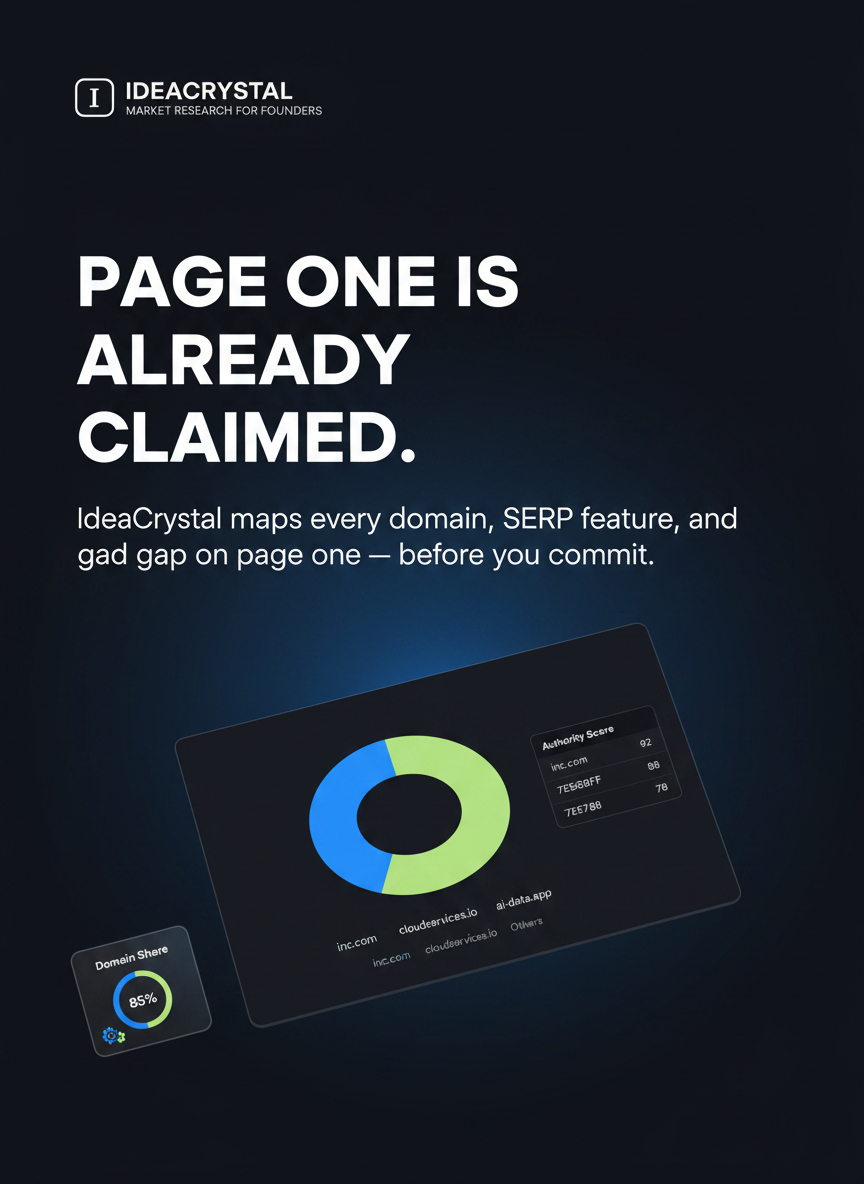
One of the most effective ways to evaluate market consolidation is by mapping the domain share of your target keyword cluster. Imagine taking every search query your potential customers use to find a solution like yours, pulling the top ten results for each, and aggregating the domains that appear.
When you visualize this data, you typically see one of two patterns:
- The Consolidated Market: A small group of high-authority domains (such as industry publications, enterprise competitors, or major directories) own the vast majority of the top ten spots. The visual representation looks like a highly concentrated donut chart. Entering this market requires a massive capital investment in authority building.
- The Fragmented Market: The top ten spots are distributed across dozens of different domains, many of which have moderate or low authority scores. This indicates a fragmented landscape where search engines are actively looking for better answers and are willing to rank newer, smaller sites that provide superior relevance.
Identifying a fragmented SERP landscape is a strong green light for organic acquisition. Conversely, discovering a consolidated landscape before you write a line of code allows you to reposition your product or choose a different go-to-market strategy before burning your runway.
Finding the Cracks: Identifying Content Gaps and Weak Domains
Even in competitive markets, a detailed analysis of the SERP landscape can reveal hidden entry points. These are the structural cracks in your competitors' defenses.
First, look for weak domains that are currently ranking in the top ten. If a site with low domain authority and thin content is holding a position on page one, it is a clear signal that the search engine is struggling to find high-quality answers for that specific query. This is an immediate opportunity for a new product to step in with superior, highly targeted content.
Second, analyze the People Also Ask (PAA) questions. These queries represent the exact pain points and clarifying questions your target audience is typing into search engines. Often, competitors rank for a broad head term but fail to address the specific, nuanced questions found in the PAA boxes. By building a product and content strategy that directly addresses these unanswered questions, you can capture high-intent traffic that your competitors are ignoring.
Finally, look at the SERP features themselves. Can you claim the featured snippet by providing a more precise, structured definition? Can you optimize your content to appear in the AI Overviews? These tactical opportunities only become visible when you analyze the live SERP data rather than relying on static keyword lists.
The Go/No-Go Framework for Organic Channels
To help technical founders and product strategists make objective decisions, we recommend using a simple Go/No-Go scorecard for organic channel viability:
- Go: The target keyword cluster has a fragmented domain share; average domain authority of the top ten is within twenty points of your target domain; SERP features do not completely crowd out organic results; clear content gaps exist in the People Also Ask data.
- No-Go: The top ten results are dominated by enterprise brands with domain authority scores above eighty; AI Overviews and sponsored ads occupy the entire first fold of the screen; there are no low-authority domains ranking in the top ten; the search intent is dominated by comparison directories that require paid placement.
If your analysis yields a No-Go, it does not mean your product idea is bad. It simply means that organic search is not your viable path to market today. You must pivot your distribution strategy to focus on channels where you can compete on a level playing field.
Run the Decision Report Before You Commit
Building a product based on assumptions is the fastest way to join the statistics of failed startups. You do not need to guess whether your target market is accessible. You need real, live market signals to guide your strategy.
At IdeaScanner, we help founders, consultants, and operators validate their next business move before they commit time, money, code, or team focus. Our platform cross-references live market data and advanced analysis to produce a comprehensive Go/No-Go decision report.
As part of this report, our SERP Landscape analysis pulls every domain holding the top ten results for your target keywords, breaks down their authority scores, maps the dominance of SERP features, and visualizes domain share so you can see at a glance who owns the conversation. We show you the exact gaps your competitors have left open—the unanswered questions, the weak domains you can displace, and the specific queries where you can win.
Do not build your distribution strategy on a guess. Run the decision report, analyze the evidence, and validate your next move with confidence.
About the author
- Validate ideas before you build. AI-powered deep market research for founders. Find demand, risks & winning angles.
Comments
Join the discussionNo comments yet. Be the first to comment.