The Politeness Trap: Why Customer Interviews Are the Most Expensive Way to Validate a S...

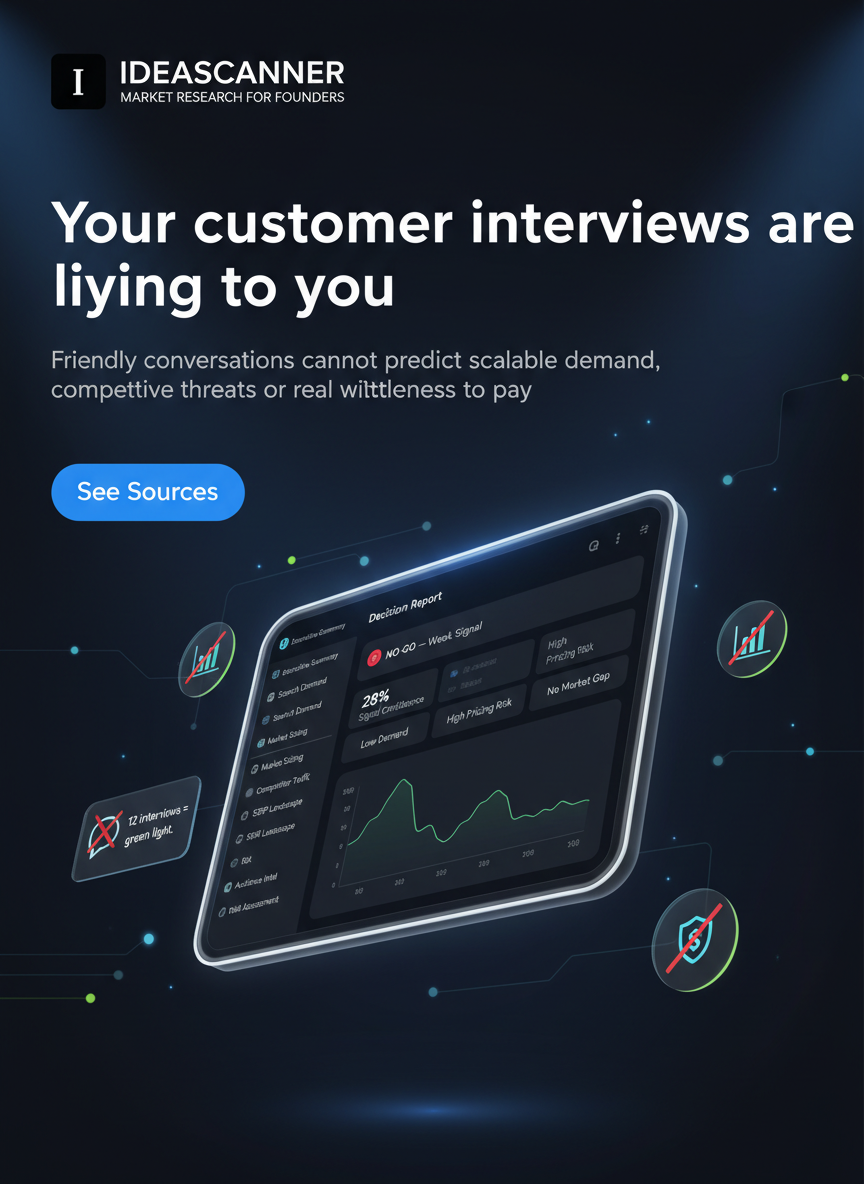
The prevailing startup gospel tells founders to "get out of the building" and talk to customers. So you do. You schedule dozens of calls, run thirty interviews, and compile pages of notes. The feedback is glowing. People nod along, call your concept "interesting," and agree that the problem you are describing is indeed a pain point. You interpret this politeness as product-market fit.
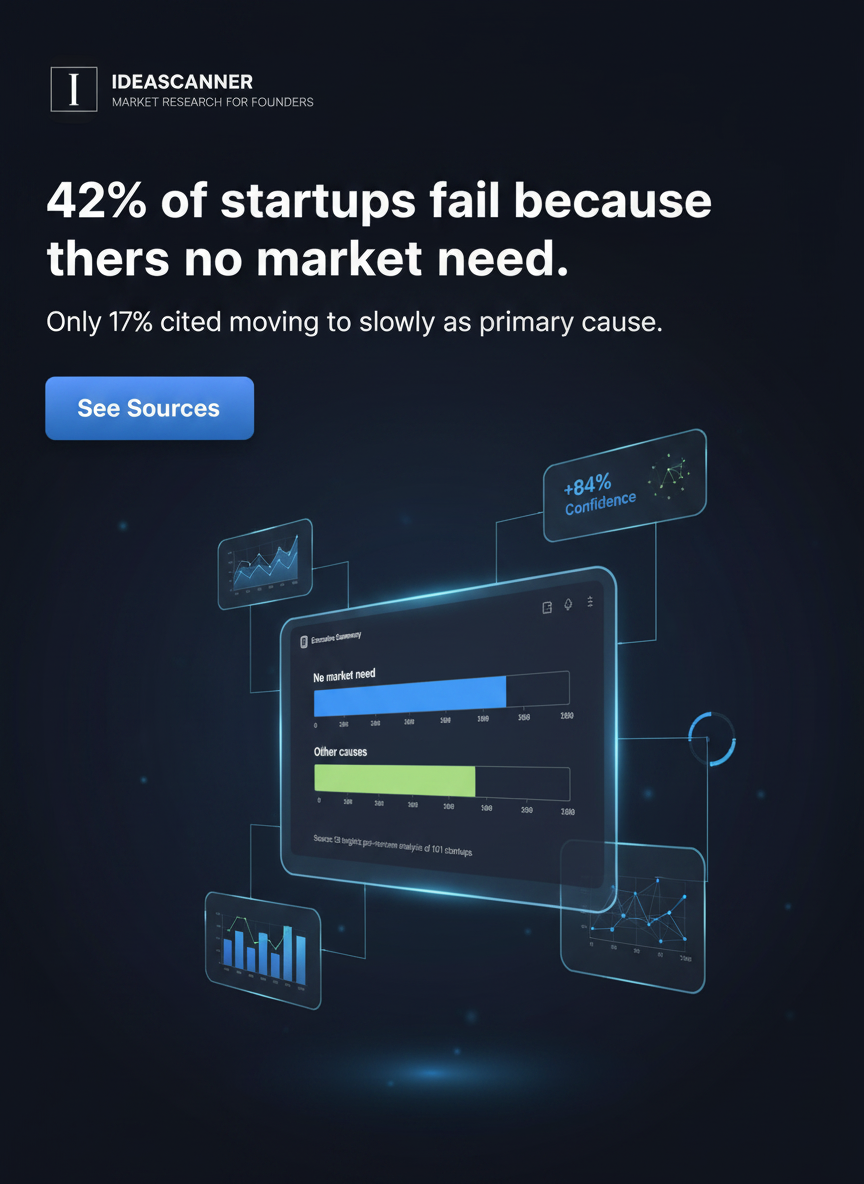
This is the most expensive misread in software development. It is the primary driver behind the stubborn statistic that 42% of startups fail because of a lack of market demand. When you ask people for their opinion, they give you their opinion. But opinions do not buy software.
For technical founders, SaaS builders, and AI developers, this trap is particularly dangerous. Because you possess the skills to build almost anything, you are naturally biased toward action. You look for any signal that justifies opening your editor and writing code. A polite interview is all the permission you need to commit three months of your life to a product that, in reality, nobody actually wants.
The Illusion of Validation: Why Politeness Kills Startups
When you conduct a customer interview, you are entering a social contract. The person on the other side of the table or the Zoom call wants to be helpful, encouraging, and polite. They do not want to tell you that your idea is boring, unnecessary, or something they would never pay for.
This social dynamic creates a dangerous feedback loop. You ask leading questions like, "Would you use a tool that solved this problem?" and they answer with a hypothetical "Yes." You write this down as validation. In reality, saying "yes" to a hypothetical question costs the user absolutely nothing. It requires zero effort, zero budget, and zero change in their daily routine.
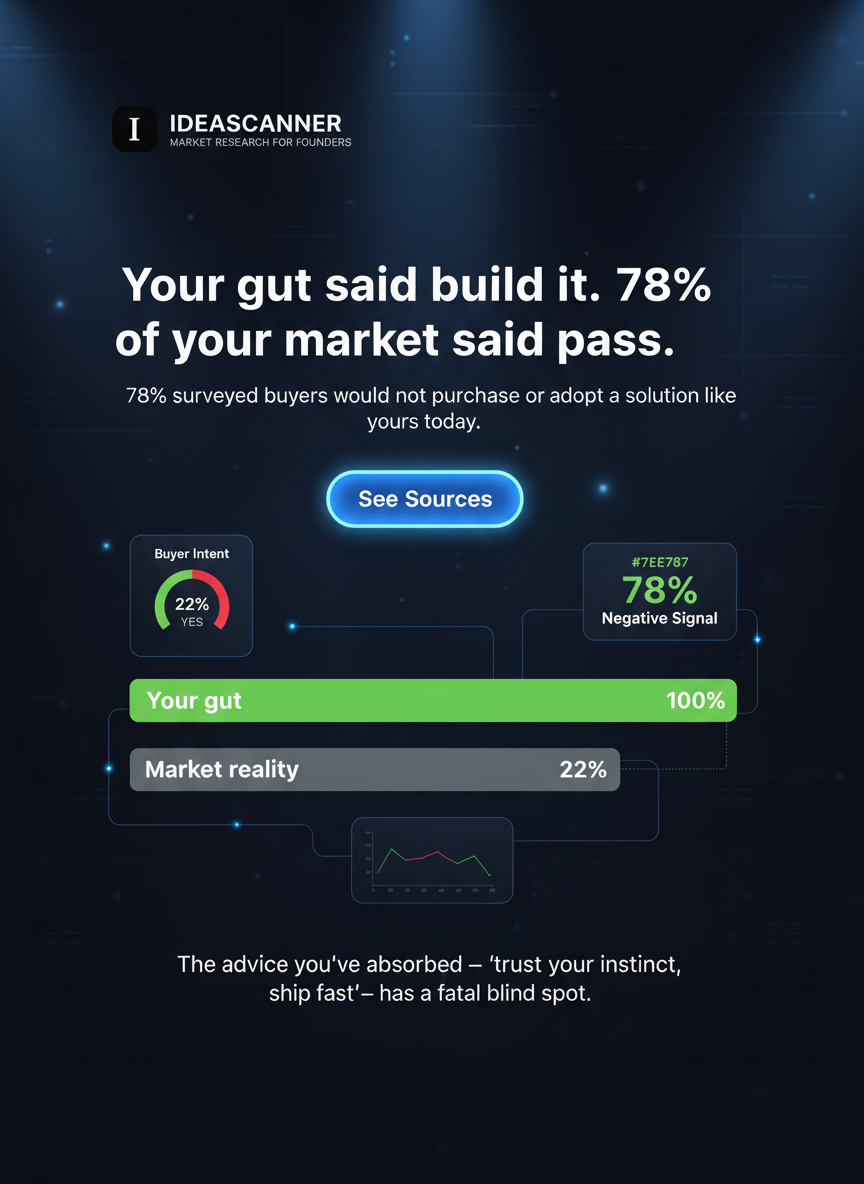
True validation requires commitment. If a user is not willing to give you their time, their data, or their money right now, they have not validated your idea. Relying on polite conversations to justify a product build is a recipe for creating a product that has no market. You end up with a beautifully engineered solution to a problem that nobody actually cares enough to solve.
The Gap Between Verbal Intent and Behavioral Reality
Talking to users confirms your bias. Behavioral data dismantles it.
Consider the reality of market demand. In an analysis of pre-launch ideas across twenty distinct verticals, only 12% mapped to active search queries with meaningful volume. The remaining 88% of ideas were solving problems that no one was actively trying to solve. They were not searching for solutions on search engines, they were not discussing them in online communities, and they were not allocating budget to solve them.
This gap between what people say and what they do is the ultimate risk for any builder. A user might tell you they struggle with managing their social media calendar, but if they are currently using a free spreadsheet and have never searched for a paid alternative, they are not a buyer. They are a casual observer.
To build a sustainable business, you must target markets where the pain is already acute enough to drive action. If there is no existing behavior—no search history, no competitor spending, no active complaints in forums—there is no market. You cannot educate a cold market on a budget.
Reading the Digital Exhaust: The Signals That Do Not Lie
The market constantly leaves digital exhaust. Every time a business buys software, every time an operator searches for a workaround, and every time a competitor runs an ad campaign, they generate data. These are the signals that do not lie.
To validate an idea, you must look at three primary categories of behavioral evidence:
First, analyze competitor ad spend. If your top competitors are spending minimal budgets on search and social ads, or if their traffic is flat to declining, the category is signaling a lack of active demand. A founder might boast that their beta users love the product, but if the market category cannot support sustained ad spend from established players, the ceiling for your growth is incredibly low.
Second, analyze search intent. Are people actively typing pain-point-related queries into search engines? If the search volume for your core value proposition is non-existent, you are facing an uphill battle of category creation. Category creation is incredibly expensive and rarely succeeds for bootstrapped or early-stage startups.
Third, examine community discussions. Scrape platforms like Reddit, niche forums, and industry-specific communities. Look for organic pain phrases. Are people complaining about the specific problem you want to solve, or are they complaining about something else entirely? If the pain is not acute enough to warrant a public complaint or a search for a workaround, it is not acute enough to justify a software subscription.
The Gauntlet: Forcing Your Idea Through Live Market Signals
The alternative to endless customer interviews is not more research; it is different research. Before you commit your time, money, code, content, team focus, or client trust to a new direction, you must force the idea through a gauntlet of live market signals.
This process requires a shift in mindset. Your goal should not be to prove your idea right. Your goal should be to try and prove your idea wrong as quickly and cheaply as possible.
If you run your concept through a rigorous market analysis and the data reveals there is no demand, this is not a failure. In fact, it is the best possible outcome. It means you have saved yourself months of wasted development time, thousands of dollars, and the emotional toll of launching a product to a silent market. You are now free to reallocate your resources to an idea that actually has market support.
Stop listening to what people say they will do. Watch what they already do. Look at where they are spending money, what they are searching for, and where their current workflows are failing.
Making the Call: When to Go and When to Pivot
For consultants, agencies, and product strategists, this validation process is just as critical as it is for SaaS builders. When you recommend a product direction, a positioning angle, or a market expansion to a client, you are risking your professional reputation and their trust. You cannot afford to base your recommendations on gut feeling or generic AI advice.
You need a systematic way to turn real market signals into a clear decision framework. This means evaluating:
- Active market demand and search volume
- Competitor positioning and ad spend
- Pricing models and willingness to pay
- Structural risks and market gaps
- A definitive Go / No-Go recommendation
This is the exact framework behind IdeaScanner. Instead of relying on subjective feedback or generic brainstorming prompts, IdeaScanner helps founders, consultants, and operators validate what to build, launch, pitch, reposition, or expand next. It analyzes real market signals to generate a comprehensive decision report, giving you the evidence you need before you commit.
Before you write your next line of code or present your next client strategy, make sure the market is actually there to support it. Check the market signals, run the decision report, and make your next move with absolute confidence.
Share this with someone building in an unvalidated market.
About the author
- Validate ideas before you build. AI-powered deep market research for founders. Find demand, risks & winning angles.
Comments
Join the discussionNo comments yet. Be the first to comment.