The Search Volume Trap: Why High-Volume Keywords Are Killing Your Product Validation
Every week, technical founders and product strategists make high-stakes decisions based on a metric that is fundamentally misunderstood: search volume.
When evaluating a new software concept, an agency offer, or a product feature, it is incredibly tempting to open an SEO tool, type in a broad keyword, and celebrate when the monthly search volume displays a five-digit number. It feels like instant validation. It looks like a massive, hungry market waiting for a solution.
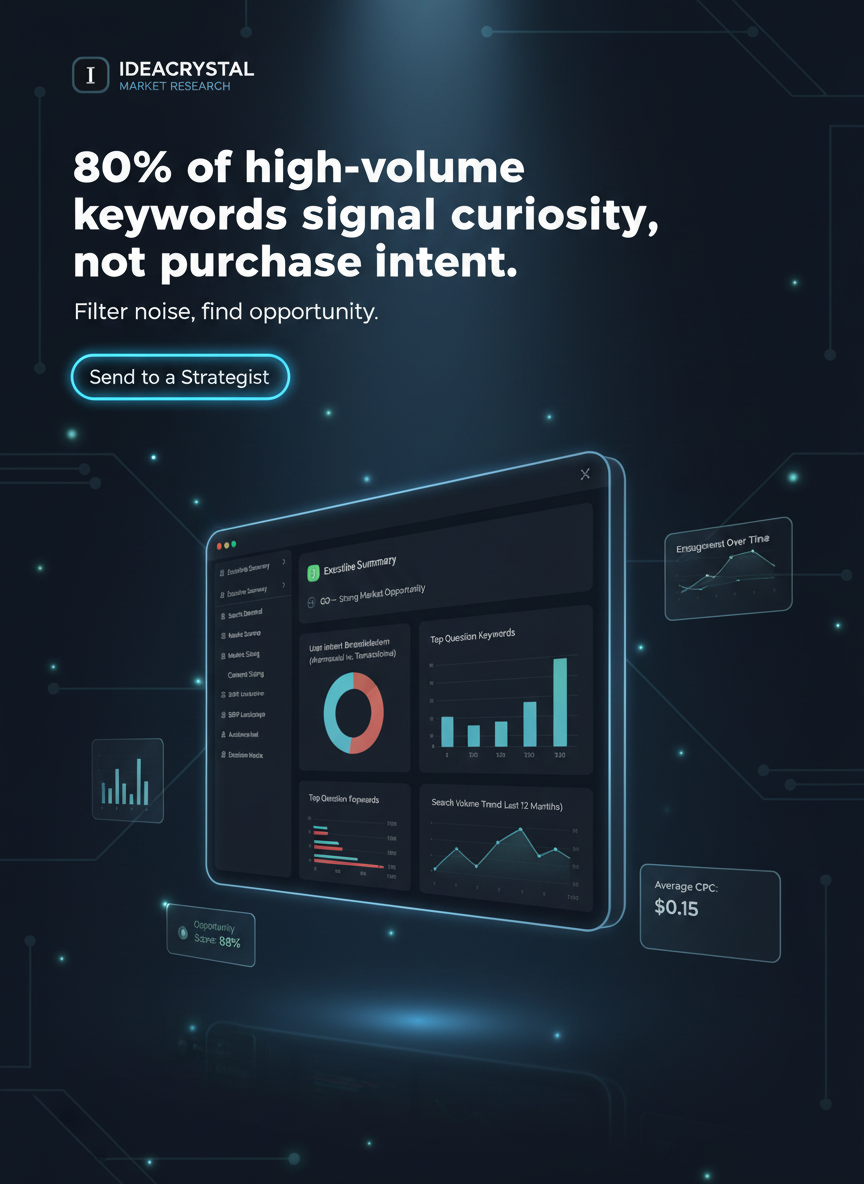
But this logic is broken. Treating search volume as a direct proxy for market demand is one of the most common and expensive mistakes an operator can make. The reality is far less comforting: approximately 80% of high-volume keywords signal curiosity, research, or academic interest, not an active intent to purchase a solution. Mistaking a crowd of onlookers for a line of buyers is a fast path to building products that generate traffic but fail to generate revenue.
The Illusion of the Demand Scoreboard
To understand why search volume is a deceptive metric, we must look at the psychology of search. The vast majority of people using search engines are not looking to buy anything. They are looking for information, trying to solve a quick homework problem, researching a competitor, or seeking free templates.
When a founder sees a keyword with 40,000 monthly searches, they often visualize 40,000 potential customers standing with credit cards in hand. In reality, that search volume represents a highly mixed audience. It includes students writing essays, entry-level employees looking for free tutorials, competitors monitoring the space, and casual browsers who have no budget and no urgent pain.
Optimizing your product roadmap or your go-to-market strategy around these broad, high-volume terms is incredibly risky. It leads to what we call the vanity traffic trap. You build a landing page, write content, or even develop a feature set tailored to a high-volume keyword. Your analytics dashboard shows a beautiful upward curve in unique visitors. Yet, your payment gateway remains completely silent. You have built an information portal for the curious, not a business for the committed.
Anatomy of the Intent Gap: Curiosity vs. Commercial Action
Let us look at the actual data to see how this intent gap functions in the wild. Consider a vertical like professional services or marketing software.
A high-level keyword like "LinkedIn agency" might pull 4,400 searches a month. To an inexperienced founder, this looks like a solid niche with decent volume. But when you isolate the search queries and look for buyer-intent modifiers, the picture changes dramatically.
When you filter for terms that indicate a real commercial conversation—modifiers like "pricing," "for enterprise clients," "case studies," or "contract terms"—the search volume collapses to a fraction of the original number. The broad keyword is incredibly noisy. It is flooded with job seekers, people looking for tips on how to start their own agency, and users looking for free automation tools.
The true commercial signal is quiet, specific, and hidden in the long-tail keywords. A term like "B2B LinkedIn lead generation agency pricing" might only get 50 searches a month. However, the user typing that specific phrase is not doing casual research. They have a budget, they have an active problem, and they are actively comparing options to make a purchase decision.
This pattern repeats across every vertical, from developer tools to consumer applications. The high-volume terms are dominated by curiosity; the low-volume, highly specific terms are where the actual transactions occur. If you only look at the top-level volume, you will systematically misjudge where the real market opportunity lies.
The Hidden Costs of Building for Tire-Kickers
When you validate a product concept using raw search volume, the negative consequences ripple through your entire business model. It is not just a matter of wasted marketing effort; it impacts your product development, your team focus, and your capital allocation.
First, it distorts your product feedback loop. When you attract a high volume of low-intent traffic, some of those users will inevitably sign up for your free trials or freemium tiers. Because they do not have a serious, high-value problem to solve, their feedback will be highly fragmented and unhelpful. They will demand features that do not align with a high-paying customer's needs. They will complain about pricing, request endless customizations for free, and clog your support channels.
Second, it wastes engineering resources. Technical founders are particularly vulnerable to this trap because they love to build. If they see search volume, they assume the market is validating their build. They spend months writing clean, complex code to satisfy a feature request from an audience that has a zero-dollar lifetime value.
Finally, it ruins your unit economics. If you acquire users who are merely curious, your conversion rates from visitor to paid user will be abysmal. Your customer acquisition cost will skyrocket relative to the actual lifetime value of the few real buyers you manage to convert. You cannot build a sustainable business on a foundation of tire-kickers, no matter how many of them visit your site each month.
How to Extract High-Intent Signals from Noisy Data
To avoid this trap, operators must look past raw search volume and analyze the underlying market signals. There are three primary indicators that help separate commercial intent from idle curiosity:
Cost-Per-Click (CPC) Data: If a keyword has a search volume of 10,000 but a CPC of ten cents, the market is telling you that those searches do not convert into revenue. Conversely, if a keyword has a search volume of only 200 but a CPC of fifteen dollars, you know that competitors are willing to pay a premium to acquire those users. High CPC is a direct indicator of commercial viability.
Community Pain Threads: Search engines tell you what people are typing, but community platforms like Reddit, specialized forums, and industry-specific groups tell you what people are feeling. Look for active discussions where operators are complaining about specific limitations of existing tools, asking for recommendations to solve an urgent problem, or expressing frustration with current pricing models. If the search volume is low but the community pain is intense and frequent, you have found a genuine market gap.
Long-Tail Specificity: Analyze the modifiers. Are people searching for "free tool to do X" or are they searching for "alternative to enterprise software Y for mid-market teams"? The presence of specific, professional, and comparative modifiers is a strong indicator that the searcher is deep in the buying cycle, not just starting their research.
By cross-referencing these three signals, you can build a much more accurate picture of market demand than any single search volume metric could ever provide.
Making the Go/No-Go Decision with Real Market Evidence
Before you commit your team's focus, your engineering hours, or your marketing budget to a new direction, you need to move beyond guesswork. You cannot rely on generic advice or surface-level metrics to validate your next move.
This is why we built IdeaScanner. Instead of letting founders rely on raw search volume or generic AI assumptions, IdeaScanner helps you validate what to build, launch, pitch, or expand next using real, multi-dimensional market signals. It analyzes the actual demand, evaluates the competitive landscape, examines pricing structures, identifies customer pain points, and highlights genuine market gaps.
The result is a comprehensive decision report that gives you a clear Go / No-Go recommendation based on evidence, not vanity metrics. It helps technical founders, SaaS builders, and operators understand whether a market actually supports their concept before they write a single line of code or spend a dollar on acquisition.
Stop treating search volume as a demand proxy. Start reading it as an intent filter. The market is already telling you who is ready to buy—you just need to listen to the quieter, high-value signals.
If you are about to make a major decision on a product, feature, or market direction, do not rely on raw search volume. Check the market signals first, get a clear Go / No-Go recommendation, and build with confidence.
About the author
- Validate ideas before you build. AI-powered deep market research for founders. Find demand, risks & winning angles.
Comments
Join the discussionNo comments yet. Be the first to comment.